

Xu Bing, Part One: The Power of Language
- Ella Wong

- Sep 21, 2023
- 3 min read
Updated: Sep 24, 2023
A meditation on language and literacy.
By Ella Wong
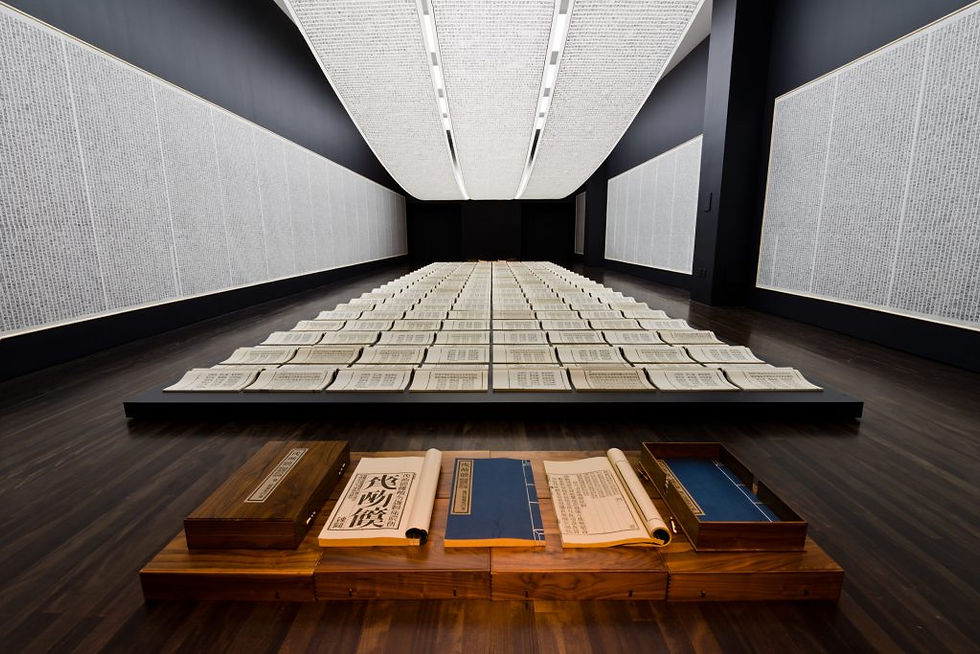
Book of The Sky, 1987, Xu Bing
In 1954, Mao Ze Dong came into power in the People’s Republic of China. His regime witnessed the advent of many things; but tranquillity was not one of them.
Having grown up amidst the Cultural Revolution, Xu Bing (1955-) witnessed a number of oppressive reforms under Mao’s rule; many of which painted targets on the backs of academics like his parents. His father was consequently sent to a labour camp, and for two years Xu himself was sent to the countryside on account of Mao’s “re-education” programmes.
Xu Bing is not the first artist who used art as a means to illustrate their experiences growing up amidst Mao’s Cultural Revolution. What sets his work apart from others, however, is his examination of written language as a tool for the powerful to exert control over others, stripping away freedoms and individuality.
One such artwork is the 1987 Book From The Sky. Arguably Xu’s most well-known work, Book From The Sky is an installation that consisted of 4000 hand-printed letters on hanging paper scrolls and hand-sewn, thread-bound books. At first glance, this installation appears to be an impressive collection of historical Chinese writing. Volumes flipped open and laid in rows upon the ground, extensive scrolls swathed from one end of the ceiling to the other, each an exemplary demonstration of traditional woodblock printing — but a closer look identifies the characters as nothing but meaningless symbols. These writings faithfully replicate the customary layout and structures used by traditional book-production, from the tables of contents to the typography of these “pseudo-characters”.
Historically speaking, education and literacy by extension was a privilege of the upper echelons. Xu’s use of traditional thread-bound books and hanging scrolls had deliberate connotations of status and power — giving the artwork an air of authority and command that easily overwhelms the onlookers. To an “illiterate” audience, Book From The Sky carries a monumental impression of superiority and sovereignty. To an audience who happens to be familiar with Chinese script however, it becomes absurdly easy to expose this facade for what it is — a string of unreadable nonsense, designed to deceive those who cannot read it.

Brailliterate, 1993, Xu Bing
Similarly, Xu Bing’s Brailliterate (1993) calls upon the overarching theme of oppression through a manipulation of language. Brailliterate is an installation consisting of seven books, laid across a table in a dimly lit reading room. The contents of the books are written in Braille, a tactile language system utilised by blind people, involving clusters of raised bumps that are to be felt by one’s fingertips. However, the English titles of these books — altered and superposed atop of the Braille covers — are entirely unrelated to their content. A sighted person would be surprised to find themselves met with pages printed in an unfamiliar tactile language. Contradictorily, a blind person would be able to read the book, but would remain unaware of its misleading English title. Thus an interesting dilemma arises; whose interpretation of the book is correct?
In such a manner, Brailliterate evokes themes of illiteracy and deception in a vein comparable to Book Of The Sky. Prior to the establishment of the People’s Republic Of China in 1949, mass illiteracy was rampant; exacerbated by gender inequality, poverty and discrimination against minorities. Mao had long been outspoken about the Chinese populace’s inability to read and write, and education reform was one of his chief goals in his role as a Communist revolutionary. He joined the Mass Education Movement under the Chinese National YMCA, in hopes of lifting poverty-stricken populations out of illiteracy. However, Mao’s work allowed him to edit pre-existing textbooks, incorporating pro-Communist sentiments with the intention of political influence7. Brailliterate brings to mind the logical flaw in this entire affair: Mao’s government claimed to provide education for all, but contradictorily subjected masses to indoctrination and propaganda. Without a free flow of ideas and knowledge, multi-faceted and objective truths are rendered unavailable to those who need it the most — just as Xu so aptly demonstrated in his half-Braille, half-English books.
This is the first essay of a two-part series exploring how Xu Bing's oeuvre examined the powerful and fickle nature of language, along with how it can be used to both oppress and liberate.
Ella Wong is a Co-Founder of and Editor-in-Chief at DILF Collective.

Comments