

Xu Bing, Part Two: The Fickleness of Language
- Ella Wong

- Sep 21, 2023
- 2 min read
Updated: Sep 21, 2023
A meditation on language and literacy.
By Ella Wong
“To change the written word, is to strike at the very foundation of a culture.”
- Xu Bing

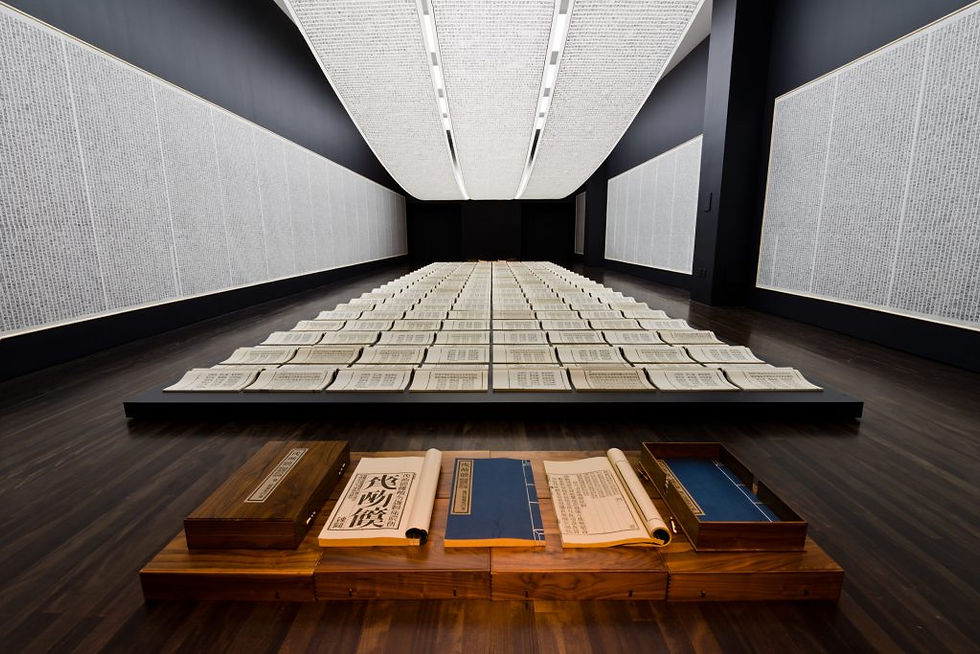
Square Word Calligraphy, 1994-Present, Xu Bing
Not all of Xu Bing’s works are critical of the use of language. Some of Xu’s other artworks — many created in the later years of his artistic career — celebrated the freedom of expression and the freedom to acquire new knowledge.
A catalyst in his production of such works was Xu’s immigration to the United States in 1990, following the 1989 Tiananmen Square Massacre and consequently increasing political pressure on artists whose works could be interpreted as criticisms of the government. Xu’s experiences as a recent immigrant informed his interest towards the perceived dichotomy between English and Chinese, as well as Western culture and Chinese culture at large.
In particular, Xu’s Square Word Calligraphy (1994-present) is a befitting embodiment of his identity as a Chinese American artist. Through the use of traditional Chinese calligraphic techniques and stylistic positioning, Xu created “pseudocharacters” once again; this time reconstructing English words into characters that appear to be Chinese at first glance. Xu assigned a radical to every letter of the alphabet — some with real Chinese roots; some entirely invented by the artist. In this way, sentences could be calligraphed completely in English, whilst still paying homage to long-standing Chinese scholastic traditions. Connecting his identity as an immigrant to the English language, this amalgamation helped dilute the disconnection between Xu’s standing in his home country and his place in a foreign country.
During his time spent as a youth amidst the Cultural Revolution, Xu learnt to create propaganda posters at school in the preferred Communist style; often aggressive and straightforward. In his home however, Xu’s father would privately teach him about Chinese imperial history, along with its rich and evocative traditions in calligraphy. To Xu, his life at home and in public had to remain separate; setting apart his scholastic homeschooling from the external changes to the Chinese language put into motion by Mao. Square Word Calligraphy reads almost like a rejection to this suppression and need to conceal one’s individuality in fear of persecution. Representative of the marriage between Xu’s dual identities, the work acted as a strangely synergistic middle ground that celebrated the freedom to learn, and the freedom to express oneself in innovative ways.
Coloured by his experiences growing up amidst the Cultural Revolution, Xu Bing’s work examined the powerful and fickle nature of language, along with how it was used to both oppress and liberate people or ideas. From works of political criticism such as Book From The Sky (1987) and Brailliterate (1993), to works of hope and freedom like Square Word Calligraphy, Xu Bing’s oeuvre calls upon the audience to not only contemplate language as a vehicle through which messages are conveyed, but also as a tool; one with the power to manipulate and educate.
Ella Wong is a Co-Founder of and Editor-in-Chief at DILF Collective.
Comments